


135th Henry George Commemorative Dinner Address by Mr Adam Creighton, Graduate House, Thursday, 17th September 2026.
Matt, thank you very much for the introduction.
Look, it’s a great pleasure to be here. I’m very grateful to the committee for reaching out to me, and Rayna in particular, when we had a nice tea, actually, on Collins Street some months ago, I believe. One of those magnificent tea houses that was a product of Melbourne’s land wealth in the 19th century. And as a Sydneysider, sorry, I’m just ad-libbing now, obviously—but as a Sydneysider who moved down here last year, it’s just striking how magnificent this city is. And it really does irritate me how much bad press it gets because although it may be badly governed, it’s a spectacular city.
The architecture is sublime.
And I’ve had several conversations with both Grok and ChatGPT about Melbourne versus
Sydney architecture, and I can tell you Melbourne craps all over Sydney in terms of anything pre-1950. It really does, and you can see that. So I chose this title because I wanted to choose a title that would not say anything in particular. When I agreed to the speech, because as a former journalist, I leave everything until the last minute. Still, unfortunately, even though I’ve been at the IPA now as chief economist for one and a half years, this was written, let’s say, fairly hastily, but “past, present, prospects” means I can basically talk about anything, and I wanted to talk about Australia because that’s our passion, that’s our collective passion.
Okay, well, let me start reading what I actually have to say. So it’s a great honour to give the 135th Henry George commemorative address, slightly intimidating. There are very few institutions in Australia that can say they’ve been holding the same dinner since 1892, probably the only one. I imagine—I haven’t researched that, but is there anything else? Well, that’s striking, and that actually goes to my whole point about why Australia is the best place to talk about this sort of thing, but it’s so special in regard to land reform. Governments have risen and fallen, currencies have changed, two world wars have intervened, and the tax system has expanded beyond anything Henry George could even conceive now. Prosper is still here, and I was just saying to Rayna tonight that I’m not a member, but I will be by the beginning of next week. I’m sorry about that; I should be a member, and you should charge more for membership!
I want to stress at the outset that these are not the views of the Institute of Public Affairs; they are my views – very much so – I’ve not run this by anyone at the IPA; these are purely my thoughts.
And I want to acknowledge that we have an MLC here tonight. We have Ann-Marie Herman here. Thank you for coming; it’s nice to have some parliamentary representatives. And of course, the President, Vice President, Treasurer and the Prosper board members who are all here—thank you very much. And we have other think tank people, so thank you for coming.
Now, I won the EJ Craigie Award in 2017, and I was very, very proud of it. In fact, the trophy is exactly the same as the one you just demonstrated to the audience, exactly the same brown wooden monument. I still have it at home. I’d never heard of the award at the time. I remember getting an email from someone saying you’ve won a prize. I was like, okay, great, and I remember flying down to Melbourne. It was pouring rain, and the event was not here; it was somewhere else. I think it was Docklands, actually; is that right, Bryan? Anyway, it was a memorable event, and I was very proud to win it, I must say. The title was “Land levy an efficient, moral revenue raiser.” It was 28 August 2017, which is deep in what I call now “the before times”: before COVID, before the world changed for the worse. And, you know, I read it again, and I’ve written a weekly column for about 12 or 13 years, so there’s a lot of them, there’s a lot of repetition I must say—sorry! But this one was very good, and I was shocked at how good it was. I thought: I can’t write like that anymore.
I forgot that Churchill, whom you mentioned tonight… it just reminded me of the kaleidoscope of people who agree with this principle about taxing land rather than other things.
I started it like this: I wrote, “The landlord renders no service to the community; he contributes nothing to the general welfare; he contributes nothing to the process from which his own enrichment is derived”, and then I cheekily said, “Who said this? Surely a left-wing propagandist” … that propagandist continued: “Roads are made, streets are made, services are improved, electric lights turn on, and all the while the landlord does nothing, and every one of those improvements is affected by the labour and cost of other people and the taxpayers.”
Then I wrote, “Actually, it was Churchill”, the archconservative as most people would say, him speaking in the House of Commons in 1909. Well, maybe I got that location wrong because Matt said earlier he was speaking somewhere else.
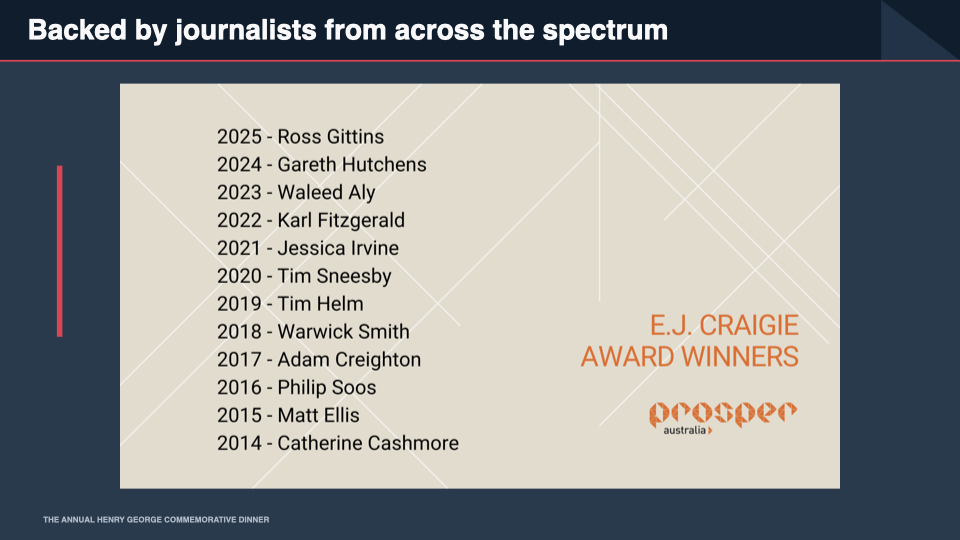
So, looking at the list of previous winners. I think it’s fun to see the list of past winners because Jess Irvine, Waleed Aly, Ross Gittins, who won it last year, Gareth Hutchens. You don’t know the internals of journalism, but quite a lot of us hate each other, so when I saw the list I thought, gosh, how funny. People far more profound than those on this list have all agreed as well from different sides of politics.
So, my address tonight is “An Australian Land Tax: Past, Present and Prospects”. It’s a good topic because Australia is just so interesting, a laboratory in so many ways. We should be proud of that era.
Now, the subtitle is “The most unsuccessful great idea in history”. I came up with this line just a few days ago. I have thought about it ever since. Land tax has not been a great empirical success, let’s face it. It’s a tiny share of most taxes, as you know. I’m sure 90 per cent of the audience know it’s a great tax. I’m going to leave those quotes with you. I’m not going to read them out. So if you get bored with me, you can read them, but it’s just extraordinary the number of brilliant minds from our tradition that have supported land tax.
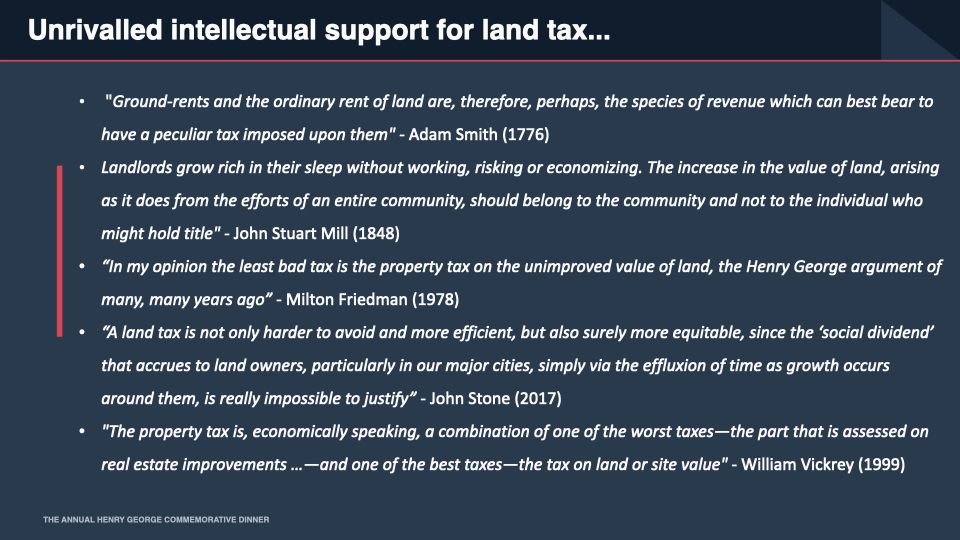
Oh, by the way, the John Stone quote, you won’t have read that anywhere else because he gave that to me via email for that column in 2017. He recently passed away in his 90s. He was Treasury Secretary and was known as an archconservative. They used to refer to Treasury under him as the Stone Age. It was a very powerful statement which you probably wouldn’t get a Treasury Secretary now to say because they’re just not as intelligent.
But anyway, it’s difficult to think of a tax with as impressive a fan club as land tax. Now, when I said ‘unsuccessful’ earlier, I mean the important distinction is it’s been successful, I think, where it’s been applied. But it’s just that it’s been applied in very few cases, at least as a pure land tax.
I learned in researching this speech that there are only three jurisdictions in the world: Denmark, Estonia, and, according to the OECD, New South Wales, that have one. But I’m not sure about that because I have a property in New South Wales, and I recently got the rates notice, and I don’t think it’s a pure land tax. So I think the OECD is wrong about that. Maybe it’s just two. It’s not a lot. How many countries are there? 192 or something? It’s not a lot.
Past, Present, and Prospects. The alliteration wasn’t intentional, but as a journalist, it was nice that they all start with P. I’ll spend basically a third of the speech talking about each.
The Past
Well, let’s talk about the past. I won’t necessarily talk to the slides, but I just want them there so you can read something if you find me droning on a bit. So, of course, Henry George made the land tax proposition famous with his best-selling Progress and Poverty in 1879. It’s just extraordinary to recall the statistics: three million copies sold in the United States; it was the best-selling book, I’m told by a few websites at least, in the entire 19th century, except the Bible.
Which is really quite something because I bought it recently online and started reading it, and it’s very dense and very difficult, right? The best bits are at the end. I didn’t get there. I just happened to think, my God, how could anyone with ten years of education, at age twelve or thirteen, which most people had at that point, buy this book and understand any of this? And it just made me realise that, when my grandmother got her first prize in maths in, I don’t know, 1940-something, she must be a complete genius by today’s standards because the standards have just fallen so much.
Probably everyone here is very well familiar with the Georgist arguments, but I do have to go over them. The attraction of taxing land is moral and economic. That’s the unique genius of George. I mean, most economists don’t; they forget about the moral aspects, even though, of course, as some of you know, economics is moral philosophy basically.
Adam Smith was a moral philosopher. ‘Economics’ didn’t really come along until the 20th century. It really still is, really. It’s kind of trying to be a science, but it’s not. In fact, trying to be a science has made many people hate it, in my view. And believe me, I studied it for eight years at the University of Wollongong, the University of New South Wales, and the University of Oxford; I studied economics for a long time. And land tax was never mentioned. It was only as a journalist that I came across all this in my early 30s, and it was an epiphany. It’s like, this is brilliant; it’s incredible!
And then, of course, I madly wrote about it for a few years, and I still think it’s special, and it upsets me that not enough people think it’s special because they just haven’t heard about it. I mean, my assistant Archer is here tonight, and he’d never heard about this until just last week, and he’s got a first-class honours degree in mathematics.
So, as you know, land is not produced by its owner; it’s a gift of God, a gift of whatever God, whatever you want to call it, but it was there before us. Its value depends overwhelmingly on location, population, infrastructure and the activities of the surrounding community, like when a railway station pops up. Which it actually has near me: Anzac Station in Victoria. I’m very happy to see it has popped up since I bought, so I’m a beneficiary now. And by the way, the federal government’s going to sell Victoria Barracks, which is all I care about right now; what are they going to do with Victoria Barracks? Because if they turn it into more apartments, my land value goes down. If they make it a park, it goes up. So you know this stuff is very real to people.
You know, we tax wages heavily more than any other country in the OECD, and you discourage work; you tax company profits; you discourage investment; you tax transfers of houses, people don’t move. But the tax on the underlying site—this is the beauty of the Georgist tax—you just tax the actual land. In practice, that can be difficult sometimes, but it’s not insurmountable.
In 1836 there was a Hobart journalist called Henry Melville, and he advocated that all Crown revenue should be raised by a tax on land, so that’s significantly before George. The point there is, Australia has a real tradition in this because I guess the British arrived and there was a hell of a lot of land, and so land really dominated all political questions right up until the early 20th century.
I’m just digressing here, but as you know, the whole argument why Australia and Argentina diverged is because in Argentina the squatters won and in Australia they did not. The government basically kicked them off and said, “No, we’re going to be in control of who owns this land; you will not be. It’s not going to be a series of princes who own the entire country.”
And so the great question was: how do you break up these huge estates? So the circumstances of land tax grew out of the colonies on these vast tracts of land where there was rapid growth and large pastoral holdings. Melbourne was at the forefront of this, obviously, given how rich it was, almost certainly in the top three or four in the 1880s.
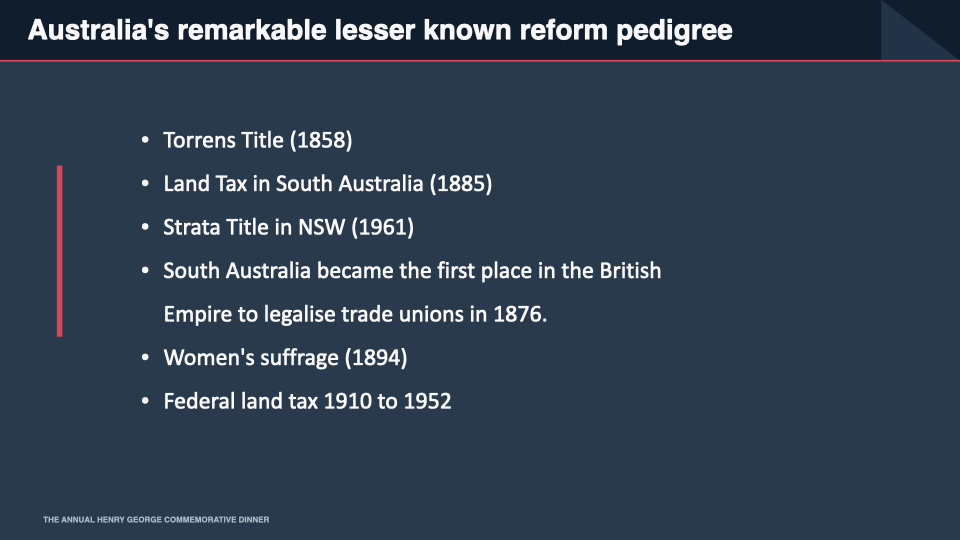
I’ve put up on this slide Australian land innovations. When people think about Australian
inventions: the cochlear implant, the Hills Hoist, Wi-Fi and all that, but no one ever thinks about these things. It’s actually a very impressive record, and by the way, strangely it’s basically all from South Australia. Women’s suffrage was first in South Australia – I just put that in for fun.
But trade unions legalisation too, South Australia; land tax, South Australia; Torrens title, South Australia. It was a unique little colony; it really was. Never took convicts, as far as I remember. I think Western Australia took a couple hundred.
And then strata title emerged first in New South Wales: I was reading just a few months ago a piece in the UK from a think tank about how messed up UK law is in relation to apartment ownership, and they were extolling the virtues of New South Wales strata title. Apparently New South Wales invented it in 1961—the whole idea of common ownership of a lot with many people living in apartments. Before that, it used to be very difficult to get anything done; it was all company title. Those ideas have been exported to most countries in the world.
Henry George, of course, made land tax very famous, as we know. I mentioned already that it’s moral and economic. Land is not produced by its owner; its value depends on everything else. That, you know. But like I say, George only popularised an idea that was already known. John Stuart Mill had favoured land tax before that. Adam Smith had favoured land tax before that.
I’m grateful to Rayna for a press clip which she gave me from the early 20th century. There was a visiting senator from Colorado who went to South Australia, presumably, and the Premier Frederick Holder was asked how the land tax had been successful; as I said earlier, the state had one since 1885, before any other state, and he answered, according to the news report, “Unhesitatingly, yes”, and said there would never be a chance of any repeal. Well, of course that didn’t happen, but it is just a reminder that it was considered a very sensible thing to do at the time, and some clearly were very excited about it.
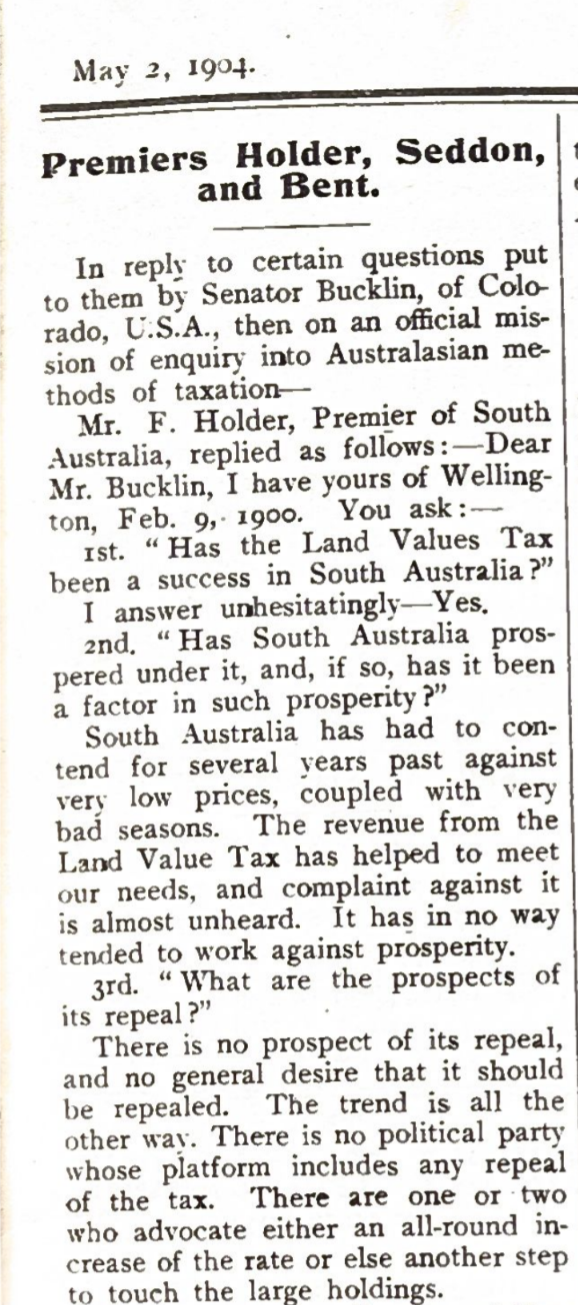
Image: Progress, Issue #1, May 1904.
So Henry George came to Australia in 1890, just before the big crash at that time. Politics was a lot more philosophical then. Herbert Heaton wrote this wonderful article in the 1925 Quarterly Journal of Economics, which I rely on heavily for this section. He observed in 1925 that George’s influence had been so considerable that prominent Labour politicians would have privately admitted that, really at heart, they were free traders and ‘single (land) taxers’. And George, of course, when he came, as you know, drew enormous crowds by proportion of the population, packing halls. He was ‘front page of the newspaper’ famous. I mean, it’s hard to comprehend now. Let’s say an equivalent might be Thomas Piketty today, but he would never command anything like that.
Not many Australians know that in 1910 the Australian government set up a land tax, the federal government from 1910 to 1952. It was progressive. It was on unimproved value, and there was an exemption for the first £5,000. And if AI is correct, that’s $764,000 Australian dollars today, which sounds about right, to be honest, if one was going to do it properly today.
Specifically, in 1910, the tax was 0.42 per cent of land value above that. I’ll have some slides later on what that would raise. The concentration was very interesting. Heaton recorded that in practice half of the assessed tax was paid by 2 per cent of the population. So land was very, very heavily concentrated amongst a few hands. Far more so than now.
Heaton, like any good economist, was sceptical and said it wasn’t an entire success. He said the whole period had led to too many dismissive attacks on pastoralists and rich people basically, and there was this great passage that you just don’t write anymore. People wrote much better, not just in 2017 when I wrote my column. He said that there were many attacks on ‘the vulgarly rich, the reactionary in their political views, and the selfish in their outlook’, and he was talking about the landholders with very large estates. But he also said that, at the end of the day, they sustained the exports of the country.
Now, the federal land tax didn’t last very long. By 1952, it was gone. During the First World War, state and federal governments had expanded massively, with a huge increase in income tax. I mean, it became a rounding error basically.
The Present
Now I want to talk about the present. The strangest feature of Australian taxes is that we’ve spent a century increasing taxes on things we want more of: work, effort. As a journalist, I always loved making fun of politicians, and there are certain phrases such as “effort and innovation” they love to say are so important. Well, we tax the crap out of that.
We have extraordinarily high marginal income tax rates – extraordinary. And the top rate, which, when I started as a journalist in 2012, I wasn’t so concerned about, and I rarely wrote about it.
Just a bit of my background: my parents left school at 14. I wasn’t from a rich family, but I did well at school, you know, effort and all that. And I always had a bit of a lefty on my shoulder. My dad was a tradesman in the printing industry; his company did the phone books. He’d come home with ink on his hands; he was a compositor, a trade that doesn’t even exist anymore. No one even knows what a compositor is these days! My dad would tell me it was the queen of all the trades, the only trade apparently where you had to be able to read.
Anyway, back to the top marginal rate: Rudd set it at $180,000 in 2008, and if it had been indexed just at CPI, it would be at $280,000 now, but it’s $190,000, which is shockingly bad. So we tax personal income very heavily: state tax, payrolls, insurance, property transfers; we have huge stamp duties on property transfers, one of the highest in the world, except, I think, Belgium. I’m surprised anyone does anything in Belgium; the taxes are so high. I don’t know why anyone gets out of bed, but some people do obviously, which is good. You know, the indomitable human spirit and all that.
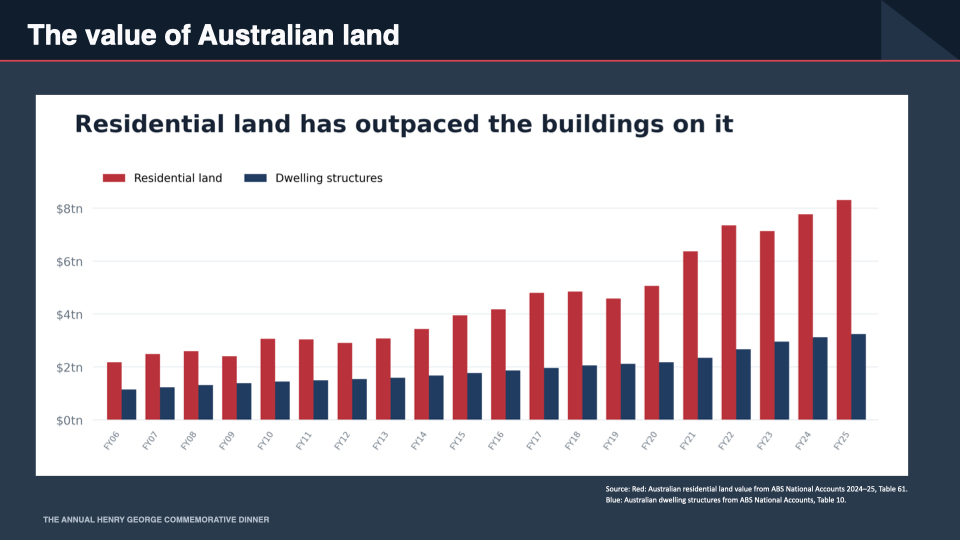
Now, let’s see some numbers on the value of land in Australia. It kind of staggered me when I put this together. The land has been growing extraordinarily. The dwellings aren’t really worth that much, though, note. When people talk about house prices in
Australia, it really annoys me because it’s not about the house. The house is not worth very much at all; in fact, the house is a depreciating asset, right? Far and away, and especially in Sydney, where the land can be up to 90 per cent of the value of the property. So again, there is just so much ignorance out there about what it’s really worth.
So, eight point three two trillion dollars in 2025 was the value of residential dwellings, only three trillion being the dwellings on top of the land. If you add in the other bits and pieces, rural, commercial, it equals $10.4 trillion. So, to stress again, housing wealth is largely just land wealth really, which no one did anything for, obviously.
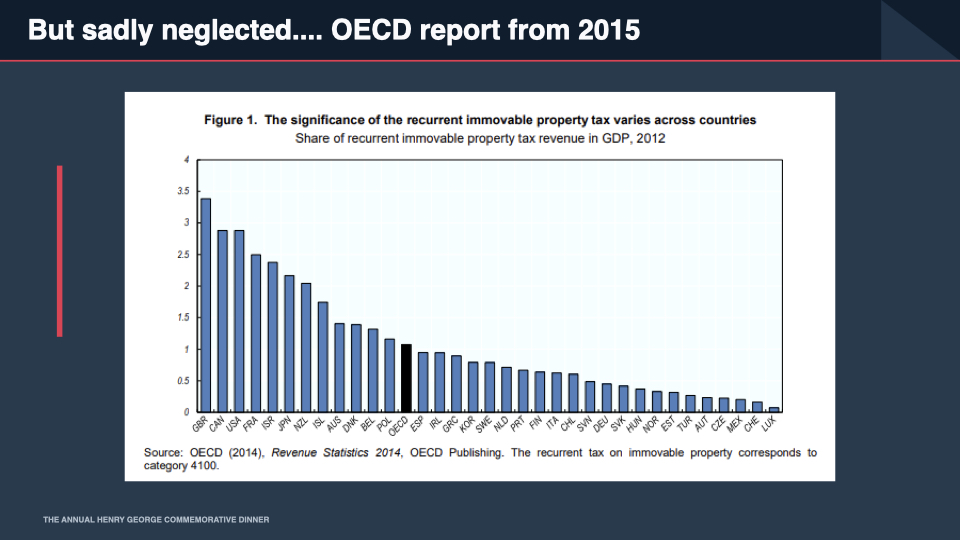
So the OECD, it’s the preeminent think tank pretty much of rich countries, and the last report they did on this was 2015, and this graph that compared countries was from 2012 data. Look at that; it’s extraordinary just how neglected land tax is, which is very sad. Now, Australia is to the left of the black bar there, but remember these are not proper land taxes; these are taxes on property, so land and also what’s on it, which is not ideal. In fact, there was a Vickrey quote earlier—the Nobel Prize winner—which said that the worst tax was taxing what’s on the land, and the best tax was taxing the land itself.
So property taxes overall are a mixed blessing. As somebody who spent four years in the US as a correspondent, it always annoys me when Americans say to Australians, “Oh, look how cheap it is to buy in Texas.” Well, yes, large dwellings can be very cheap, but there is an enormous property tax, which goes with them, which we don’t have here. Taxes owed are discounted into the price.
So this OECD paper found that almost all countries except those two earlier, Denmark and Estonia, which I mentioned, tax both together. The political obstacles to land tax remain salient.
You really know when you get the bill, which is a great virtue of such taxes in my view.
The problem is seen clearly with GST, and I’ve always hated GST because most so-called right-wing economists say, “Let’s increase the GST to 15 per cent.” And it’s even worse when they add “let’s not change the exemptions” to help the poor (fresh food, health, etc.).
Don’t forget a law passed in the Australian Parliament in 2008 made it illegal to quote prices exclusive of GST. The Rudd government passed that; it’s very sneaky. It’s because the government wants to hide the tax, right? They want to hide what you’re paying, and it’s a very, very powerful thing.
It’s actually why they prefer income tax too: since the Second World War, in many countries, they take tax out of your wages/salary before you get it. It’s been a disaster, and it’s funny, you know, Milton Friedman actually came up with that mechanism for the US government at the time when he was young, but he regretted that later because it’s been the greatest disaster ever for pumping up the size of government.
By contrast, when you actually have to pay the money to the government, it’s far harder to raise the rate. Very hard. Whatever other issues you may have with it – you have to write the cheque or send the money, and that makes it very hard for the government to increase it. With income tax, they just fix the thresholds nominally, and then it just goes up automatically every year. Or you go and buy a dress or whatever it is, and you don’t even know you’re paying GST? They could steadily lift it to 20 per cent, and people wouldn’t even know, and that’s why in Europe all these VATs are 20 per cent. It really annoys me when people here go “Let’s do that”. Do you think that they will cut income tax as well? I mean, don’t be ridiculous.
I know I’m massively digressing, but you know there are studies that show when they introduced the GST in the year 2000 roughly, the Howard government said there would be a reduction in income tax, and there was initially, but of course the thresholds stayed the same over time, so now you have the same income tax plus the GST. It’s just shocking, really.
So now, for the present, the Perrottet government; let’s talk about that.
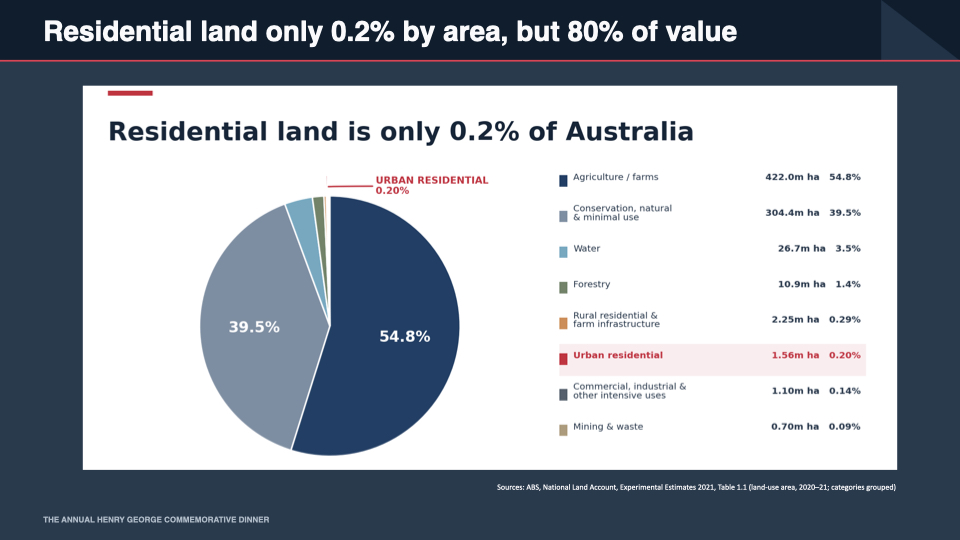
Actually, sorry, just before I get to New South Wales, note how residential land by area is so tiny in Australia, isn’t it funny? 0.2 per cent, you can see from the slide: it’s just extraordinary, really. In that Heaton Quarterly Journal article I mentioned earlier, he said that only a quarter of Australia was useful, and that’s probably still roughly true, more or less, 100 years later. But by value, obviously, it’s a very different question. That’s why I think if you were to have a land tax, you really could just focus on the residential part, and have concessional rates for the other classes of land—rural and commercial, possibly for political reasons.
But anyway, let me talk about the Perrottet government. So Dom Perrottet and I were actually quite good friends when he was a backbencher, catching up for lunch, dinner and drinks, and we would talk about things. I mean, he would say he was a bit of a DLP guy like me. So anyway, he really liked the principles behind land tax, and to his great credit, when he was treasurer and premier, he pushed through this extraordinary reform, which I think is one of the greatest reforms we’ve had in the last decade in this country.
Saul Eslake—a great economist who is also a friend of mine, whom I respect a lot, and actually I believe gave this very address some 13 years ago—he always says the worst policy decision in the 21st century was the GST allocation being skewed to Western Australia. Well, I disagree; the worst has been the New South Wales Labor Party getting rid of a program that Dom set in place, which was sadly only in place for six months. And as much as I like Chris Minns personally, for that I will never forgive him! Because he was going to win the election anyway, let’s face it. I know this is being recorded, so I won’t be completely honest, but it was very unintelligent, let me say, of the Labor
Party to get rid of that because it made no sense. I mean, this is an idea that, in some respects, is quite a leftist idea, and the Labor Party, the oldest political party, got rid of it unnecessarily, when back in the early 20th century they actually advocated for one. It’s wild to me, and it goes to my later point, which will be discussed: just how stupid everyone is these days. Labor staffers at least in NSW probably would not have a clue about what we’re talking about right now.
So anyway, Dom, to his great credit, came in with this thing that was a high risk right at the end of the Coalition’s lengthy term in NSW. It was risky. He probably knew he was going to lose, but he said, I’m just going to do this in the public interest, and he did it. It wasn’t a Georgist reform perfectly, but it was about the best you could get.
You could choose, as a new owner, whether you paid stamp duty or land tax, and that property would remain then under the land tax regime forever after. That was the key, so it’d take a hundred years or more, but in principle, eventually you get to the point where everything residential in the state was on the land tax system. Anyway, it lasted six months, but I can tell you through some research that 5,210 people chose the land tax and they’re paying the land tax still in New South Wales. But sadly, when they sell it now, it will revert to the current regime. I think those people, especially if they sell within five, ten years, or whatever, you know, got a great deal because they didn’t have to pay the absurd sums 30, 40, 50 thousand dollars to buy a family home that you do.
Mark Speakman, when he became opposition leader after Minns became Premier, said I believe, I don’t know if it’s true, that two-thirds of people chose the land tax option when the scheme operated. Which is extremely promising, to be honest, and frankly the other third can’t have been very smart unless they intended to own it for 50 years.
So the scheme closed 1 July 2023 with all the usual nonsense from Minns about no tax on the family home and all that sort of rubbish, as if council rates aren’t already a tax on the ‘family home’, which these days doesn’t have too many families in it anyway!
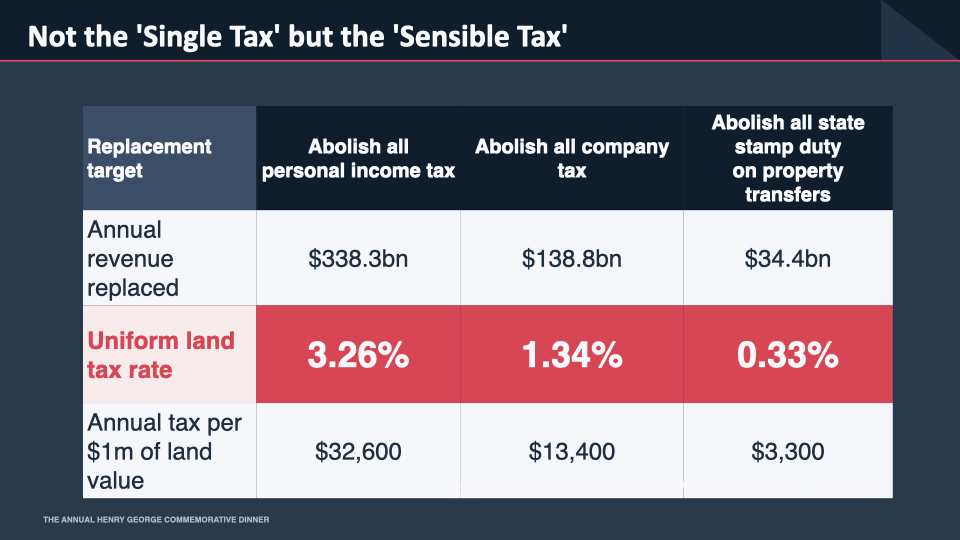
I did some calculations on what land tax would be required to totally abolish income tax,
company tax, and getting rid of all stamp duty. See it all on the slide. Now look I agree a 3.2 per cent unimproved land value tax is pretty high but you get rid of income tax. Imagine not paying any income tax!
And it’s a far lesser rate, obviously, to abolish company tax and stamp duties. Now, I also did it by capital cities; well, actually, I got my assistant Archer to do that—thank you, and you can see, obviously, it varies by where people live.
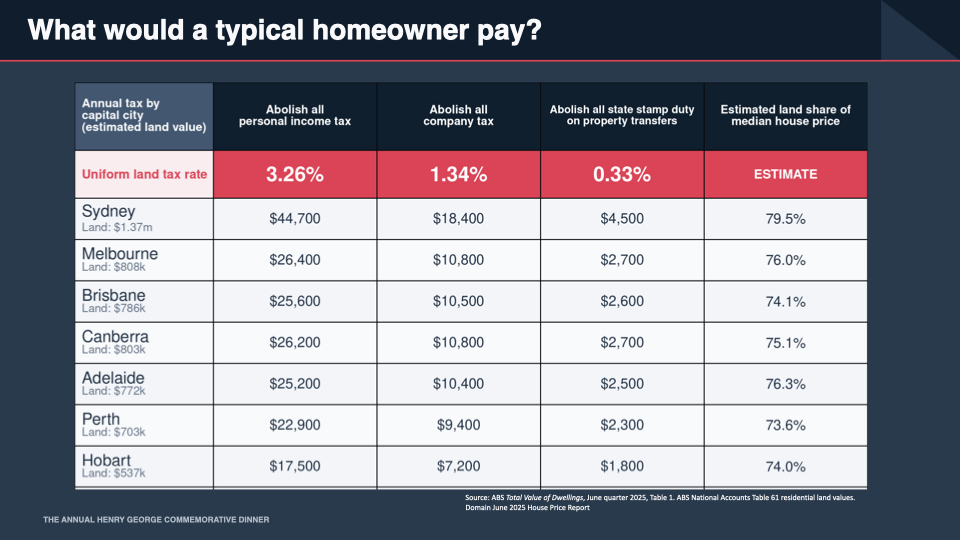
I really want to stress that for someone in the second or top marginal tax bracket who’s currently paying an enormous amount of income tax, this would not be a net burden—on the contrary, you’d be hugely ahead, enjoying a massive tax cut.
Yet we’ve still got these stamp duties when we’re in a mobile society where we expect people to move more than we did a hundred years ago when no one ever left their little village, let alone were expected to fly around between capitals. And now we’ve got much higher stamp duties, so it’s much harder to move, so the case for land tax I would say now is even stronger.
Something I haven’t mentioned until now: the ATO estimates a tax gap, which is very hard to know. Basically, if everyone was righteous and paid what they should, and there was no evasion, it would equate to about 10 per cent of the tax collection, which is huge. So I mean if you had a land tax, obviously, the great virtue is it can’t be hidden at all, so that number would be zero. I always laughed thinking about people putting a big blanket over their land and trying to hide it from the government. “I don’t really own this!” Unlike income, where you can both hide it and recharacterise it, and there’s a whole industry devoted to that. Believe me, one of Australia’s biggest industries is recharacterising income, whether it’s company income, ordinary income or
trust income. Indeed, it’s been in the news recently with the changes to CGT, and everyone’s shifting between trusts and companies and all this; it’s just all complete waste—but still counted in GDP!
So much economic activity is just worthless and destructive and immoral, I would argue, because the only people that pay tax are individuals, human beings. At the end of the day, that’s it. Your pets don’t pay it. Animals don’t pay it. Companies don’t pay tax, just people. People forget that; they really think, “Oh, the company’s paying tax.” No, it’s ultimately people that pay the tax. It’s only the incidence that’s interesting.
Let me go on.
Prospects
So now let’s talk about prospects, the third part. Firstly, maybe prospects are not great, so let me get the negative stuff out of the way first.
The attention span of the current generation is not great. I must say, I don’t know how many people in their 20s, you know, but their time spent each day on TikTok and Insta and stuff, it’s not very heartening.
When I read back to when Henry George was here in Forbes in the 1890s, a full 10 per cent of the population of the town would come out to hear his speech. That was pretty much standard.
10 per cent of people would come out to hear a two-hour lecture on tax.
In the Heaton article I referred to earlier, it said the hall in Forbes was “densely packed with a large number of ladies”. So there you go, even ladies were going! However quaint the language, it’s hard to imagine that now. Maybe Prosper needs a TikTok unit or something. I don’t know how you do that, but the attention spans of people for comprehending even slightly challenging ideas are shockingly small.
The other thing, well, yes, this was a great quote from The Argus at the time; actually, from a journalist who was following Henry George around Australia. He said George was unpopular with the landowners because they had no conscience, and unpopular with the workers because they had no brains.
That’s still kind of the same, right? The vast bulk of people, let’s say, just don’t think—I’m not going to say they’re stupid, but they don’t think enough about it. And these are the majority of people that vote. The landowners, they’re much more educated and well advised, despite being few in number back then at least.
They may think that in general, it’s a good idea, but they would not support it for their own self-interested reasons: fair enough, I suppose.
There are also outright mistaken beliefs. Since I knew I was giving this talk, I asked a few people, some people in their early 20s, what they thought of this idea of just taxing land and nothing else. And they tended to say, well, what about if there are two bits of land the same size and one person had a nice house, while the other person had a small awful house. They both would pay the same, and that’s unfair. And I said, “Oh, yes. But then the person with the less good house could sell it, and then that land could be developed in a way that everyone ultimately was better off.” But that just seemed too sophisticated, sadly.
Another thing is people don’t really own the land. They don’t. I’m sorry to tell you but the Crown has radical title over everything. This idea you buy a house, and you own it. I’m sorry, you don’t.
You’ve bought a parcel of rights and contractual obligations. That’s what you bought. You own a bit of airspace above 20, 30 metres; that’s it. And you “own” about five metres below the ground, if you’re lucky. If anything’s discovered there that’s valuable, the government owns it. There’s a Victorian Act from 1990 that says anything of any value under anyone’s residential property is owned by the state government. Full stop. So if you find gold in your garden, that’s great, but you’re not going to make much money out of it.
Then of course, there are logistics involved in imposing a land tax suddenly. What about old people, say, who don’t have much cash income? I get this but this issue is easily worked around, as I’ve argued many times in The Australian. Just let the government pay the land tax until they die. And then it comes out of their estate. It’s not rocket science, guys. I mean, you could even make it ‘no interest’. But for a lot of people, this is a really advanced, difficult idea, which they do not understand.
And then there’s the tribal nonsense, and this is why Georgism just falls through the cracks.
People on the so-called right like lower taxes on labour, enterprise, and capital. But this group tends to own much of the land, so they hate the idea for themselves.
And then the ‘left’ loves the idea of taxing land, but they don’t want to cut any other taxes.
So land tax supporters are reduced to intelligent people like those in this room who have, you know, IQs above 130 or so.
But anyway, some positive stuff now to finish up: a third of the population, a third of the voting population, are renters, and they wouldn’t pay a cent under this reform. I mean, as economists know, you can’t really pass on pure land value taxes; the incidence falls totally on the owners of the land. So a third of the population should find this policy change very good, because they currently pay income tax, and they wouldn’t pay any tax at all under this system. And as I mentioned earlier, even those who do own the typical suburban house would be way ahead as well in net terms.
The other thing is that land concentration is far less than it was 100 years ago. And specifically, the upper houses of our state parliaments used to be dominated by land-owning interests.
Whereas now, more or less, they are constructed on the same basis as the lower house, with just different-sized electorates. So that significant historic bulwark against change, which was obviously overcome in South Australia at least, has gone. So perhaps with the right political leader, maybe it’s possible to explain to people that this would be a very good idea for the vast bulk of people and voters.
The other point I have is that so many people now live in apartments; far more than 50, 30 years ago. So in the 2021 census, there were 11 million homes; apartments were 16 per cent. But 40 per cent of all the growth in homes since the previous census had been in apartments.
I don’t know how many of you here live in apartments, but if you live in an apartment, of course, your land tax would be very small, really, actually, because it’s based on the land. The total land tax would be divided by the number of apartments on it. So anyone living in an apartment should be all for this reform.
So you’ve got the renters, the typical homeowners and you’ve got those people who own an apartment. Now you’re already getting to quite a large number of people, who are obviously advantaged, who would be put in a good position by such a reform. So it’s just the leadership question. I don’t know. Maybe we’ll get a Milei or someone like that. Do you think there’s a Milei out there in Australia?
Practically speaking, if I were a pessimist, I just think the only way forward is to put the principal residence into the assets test for the Age Pension. That’s about it, really. If you could do that, that’d be amazing.
Finally, if there were a massive recession, the whole political debate would change. And on this slide, it was just a joke I put in today. Maybe if AI does take over, as some in the press are saying, then they would choose the tax rates and the tax structure, and it would all be very sensible. And then you would have a comprehensive land tax, courtesy of ChatGPT and Grok and so forth.
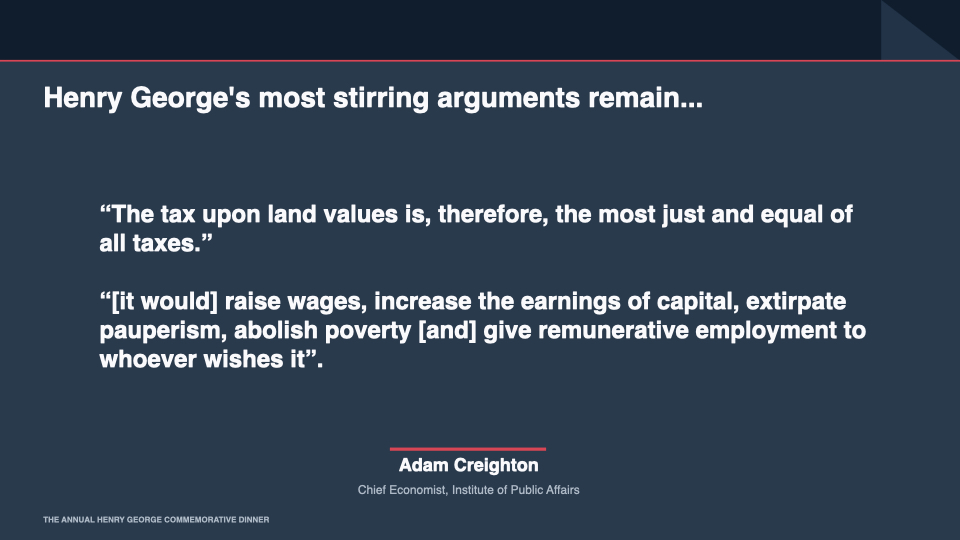
I haven’t quoted Henry George all night, but I thought for the Q&A, we’ll just put up two of these great statements of his. So the first one highlights the moral arguments for a tax on unimproved land, which most economists don’t really talk about. And the second one goes to the better-known economic arguments. So let’s have Q&A. I hope you enjoyed all that.
Prosper Australia thanks the Henry George Foundation of Australia for their support for the 2025 Henry George Commemorative Address.
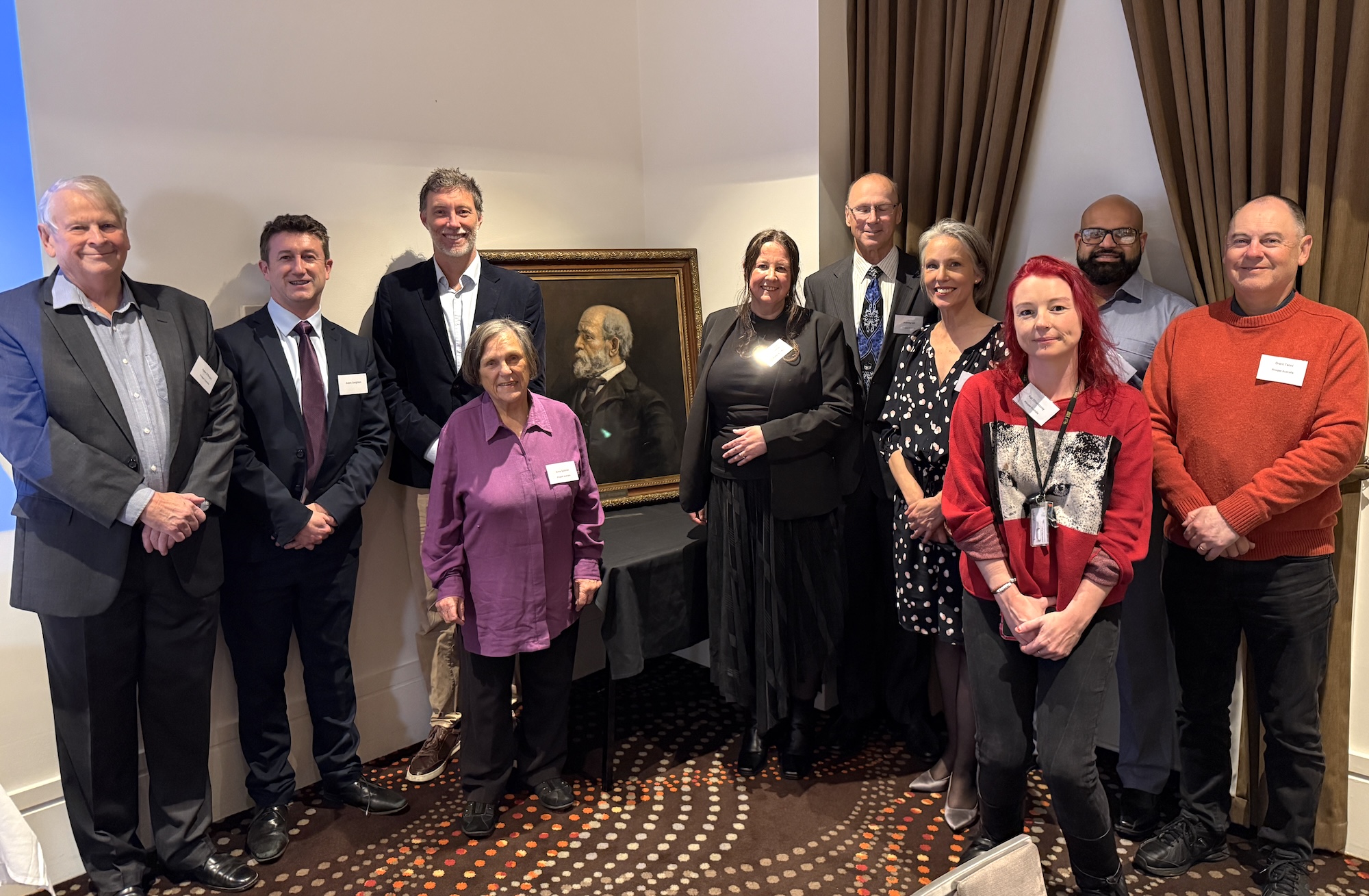
L-R: Peter O’Regan, Adam Creighton, Matt Godwin, Anne Schmid, Rayna Fahey, Anthony Gill, Juanita McLaren, Kat Chiskovsky, Michael D’Rosario, Grant Tenni.
