Prosper Australia Research Institute’s Australia’s Resource Wealth Giveaway (2026) report examines the return Australia receives from its resource wealth.
Australia is a resource-rich country, but it does not always collect a strong public return from its finite mineral and energy resources. Viable resource projects should be able to earn a commercial return on the capital, technology and expertise they invest. But those underlying resources are finite public assets, so when prices and profits surge, the public should share properly in that upside.
The report compares Australia’s resource tax and royalty system against selected resource-rich peers, including Norway, Alaska, Chile, Peru, Québec, and Queensland coal. It does this by asking three practical questions:
- First, is the system designed to collect more when prices and profits surge?
- Second, what level of revenue does the public actually collect?
- Finally, does stronger public capture automatically drive investment away?
AUSTRALIA’S RESOURCE CAPTURE IS UNEVEN
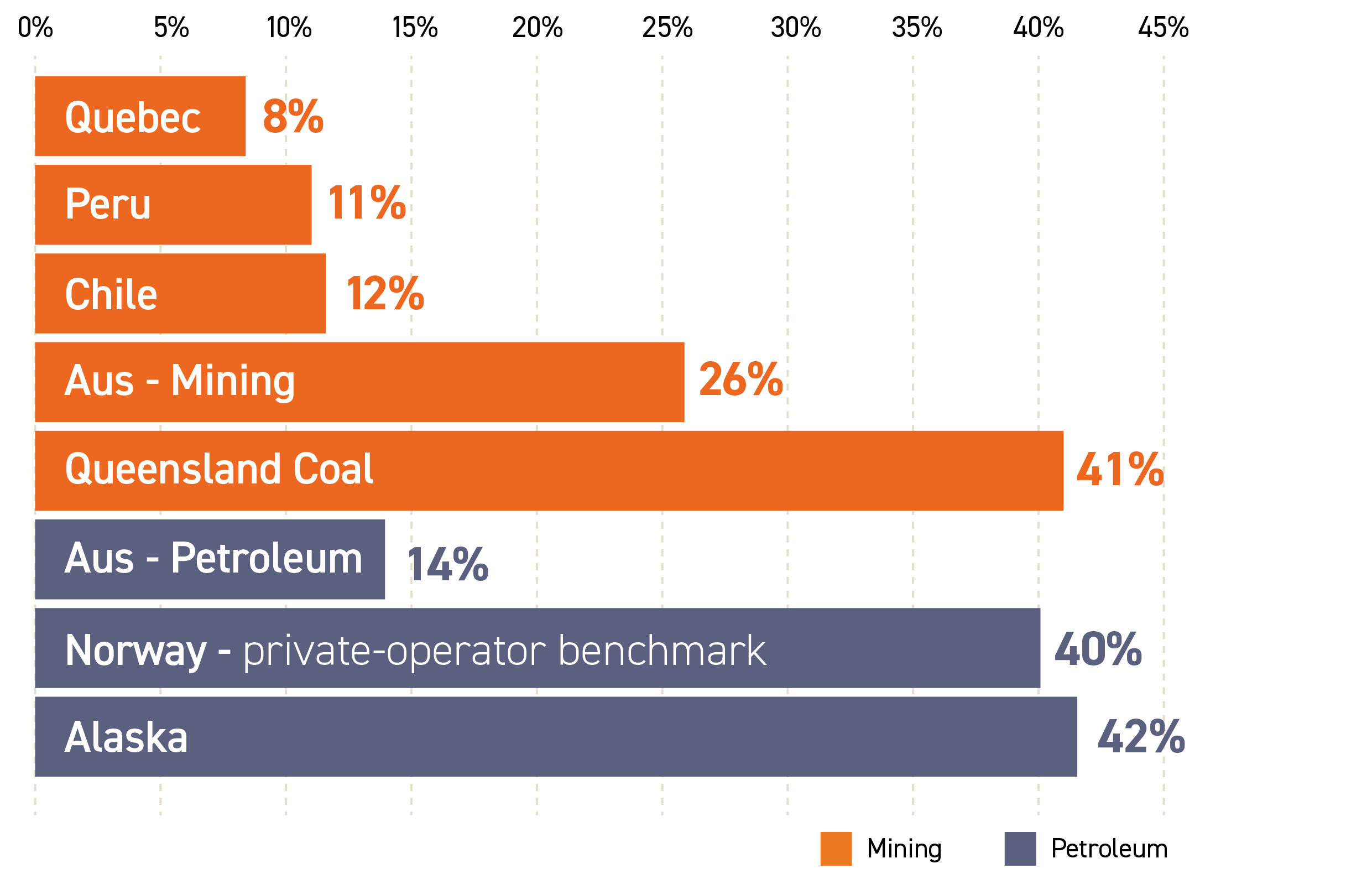
To compare what governments actually collect, this report uses a public-capture ratio measure: public revenue collected from the resource sector divided by the sector’s value added. In plain English, the ratio shows how much public revenue is collected for every dollar of resource value created.
AUSTRALIA’S RESOURCE REVENUE OPPORTUNITY IS LARGE
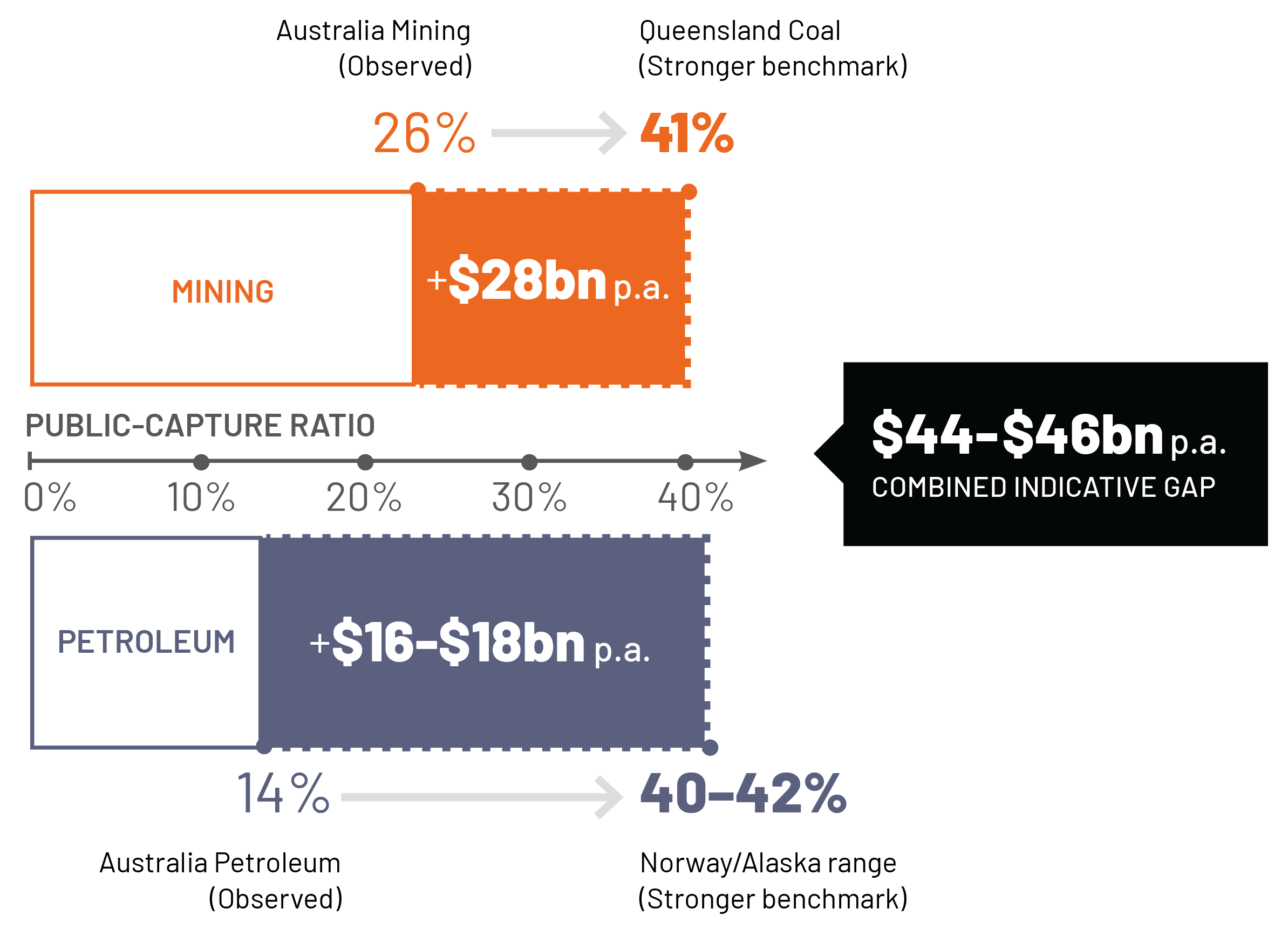
To show the scale of the revenue opportunity, the report applies stronger sector-matched public-capture benchmarks to Australia’s mining and petroleum sectors.
Stronger benchmarks imply about $45 billion more a year: Applying stronger sector-matched benchmarks implies around $28 billion per year in additional mining revenue (applying Queensland coal’s benchmark) and $16–$18 billion per year in additional petroleum revenue (applying Norway’s and Alaska’s benchmarks separately). Combined, the indicative revenue opportunity for Australia is around $45 billion per year across state and Commonwealth revenue streams ($44–46 billion range across the two petroleum benchmarks).
STRONGER PUBLIC CAPTURE NEED NOT HALT INVESTMENT
The report tests whether stronger public capture drives investment away, looking at the forward-investment pipelines across peers and Queensland’s post-coal royalty reform experience. The evidence does not support the simple claim that stronger public capture drives investment away.
KEY FINDINGS
Finding 1: Petroleum is Australia’s clearest weakness.
Finding 2: Mining performs better, but royalties stay flat in booms.
Finding 3: Queensland coal is the domestic proof point.
Finding 4: Stronger benchmarks imply around $45 billion more a year
Finding 5: Weak public capture creates a double loss
Finding 6: Stronger public capture need not halt investment
Finding 7: Queensland’s coal sector remains robust post-reform
PRACTICAL REFORM PATHWAYS
There is a clear public demand for Australia to rapidly modernise its public-capture mechanisms before more finite public wealth is extracted without a fair public return. To address this under-capture while allowing viable resource projects to earn a commercial return, the report recommends two practical priorities: modernise state royalties and address petroleum under-capture.
- Recommendation 1a: Market-linked state royalties: Market-linked royalties rise when commodity prices exceed long-run norms, so the public return rises automatically in boom conditions.
- Recommendation 1b: Consider hybrid systems: As an alternative to a purely market-linked royalty, states could combine a minimum royalty floor with a second boom-sensitive component linked to prices, profits or profit margins.
- Recommendation 2: Address petroleum under-capture: Petroleum is Australia’s clearest revenue collection gap. State royalty reform can only go so far: major offshore petroleum projects are primarily subject to Commonwealth tax settings.
Low, flat royalties are policy choices. Better choices are available.