
Economics as if location matters
In 1943, the Canadian land economist H. Bronson Cowan, director of the International Research Institute on Real Estate Taxation, visited Melbourne to conduct research in the municipalities of Brunswick and Camberwell. His techniques inspired a number of local professionals to form the Land Values Research Group (LVRG).
Under its founding director, Allan R. Hutchinson BSc MIEAust (1907–1988), the LVRG published 37 major documents. These included world-leading empirical studies demonstrating that site-value rating — that is, the imposition of municipal rates on land values alone — is more conducive to economic growth than alternative systems that include buildings in the tax base. Expressed in qualitative terms, that conclusion should be obvious: taxing buildings deters construction. Consequently impeding the industries that lie upstream or downstream of construction or require accommodation for workplaces and workers. In other words, it impedes the whole local economy. Whereas taxing the value of land cannot reduce the supply of land, because neither the land nor its value is produced by the owner. Hutchinson’s contribution was to quantify the damage done by taxing buildings, showing that it is not trivial.
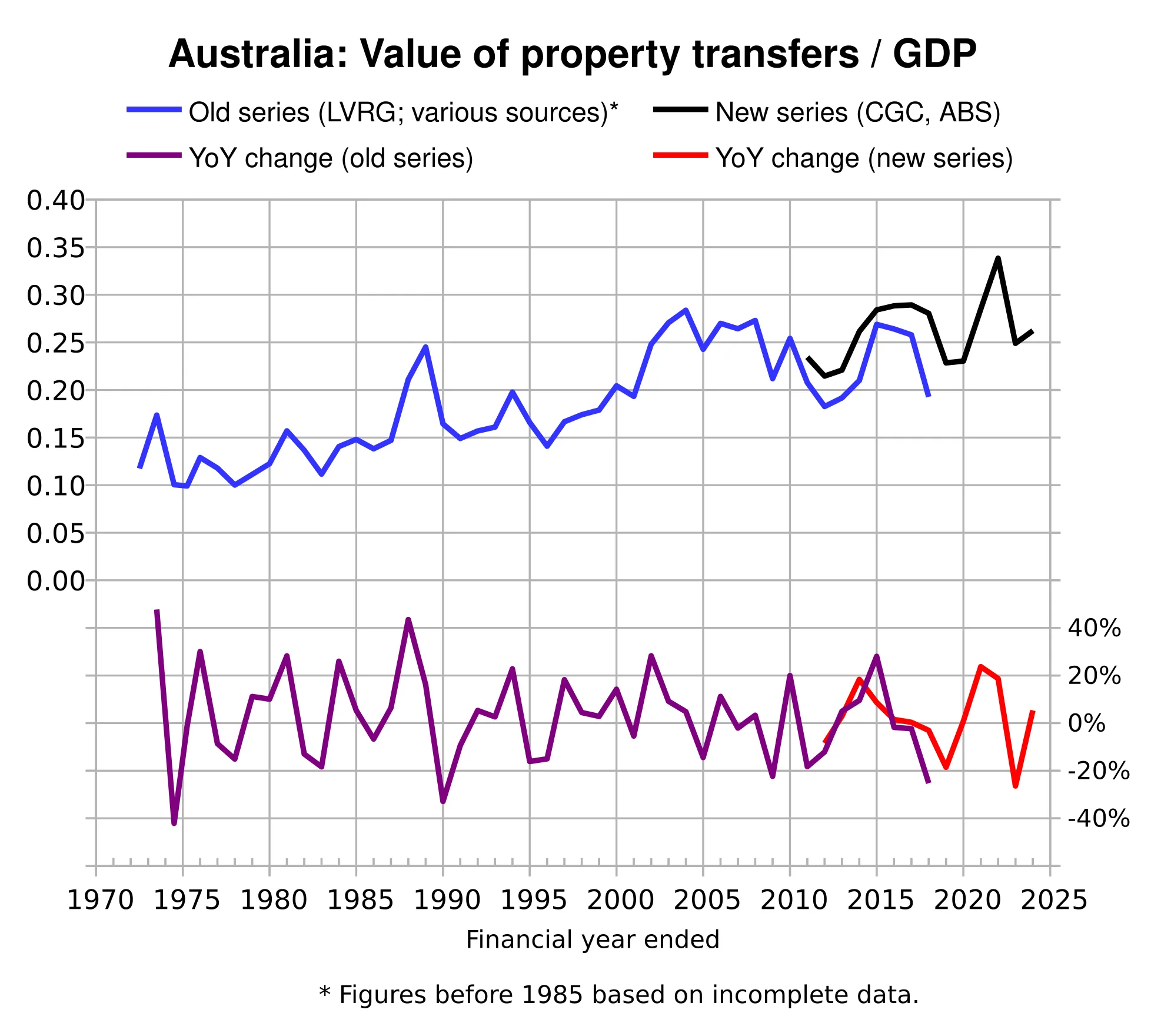
On his death in 1988, Hutchinson was succeeded by Bryan Kavanagh. As a professional property valuer and a student of Georgist economics, Kavanagh knew that the land market is characterised by bubble-burst cycles and that the bursts are followed by recessions in the wider economy. On this basis he had predicted, in an article published in The Valuer in July 1987, that the next recession would be in 1991/2. This was correct to within one year. Seeking a reliable method of diagnosing a land bubble, Kavanagh began aggregating statistics on property turnover in the several Australian States since 1972. Eventually he noticed that whenever the turnover exceeded 19% of GDP in a nationwide trend, and then returned below 19% (as it always did), recession followed within 2 years. He concluded that the ratio of property turnover to GDP is a veritable barometer of the economy, and that a ratio exceeding 19% indicates an economically damaging bubble. He is therefore unimpressed by the Greenspan doctrine that one cannot recognise a bubble until it bursts. Australian real estate re-entered bubble territory, according to Kavanagh’s criterion, in 1999 or 2000.
The volume of debt contained within the height and breadth of the recent residential bubble offers a strong degree of confidence to suggest that Australia will experience a severe economic recession within two years of the graph retreating back below the 19% bubble line.
Kavanagh received copious but tragically brief assistance from the late Tony O’Brien, whose landmark study “Land Monopoly and Income Polarisation in Australia 1950 to 2000” (Progress, September-October 2001) was published six months before his untimely death.
Kavanagh remains active in the LVRG. He blogs at The Depression.
The late Philip Day, LLB DipTCP PhD, was the principal author of the LVRG’s submission to the 1996 National Tax Reform Summit. In 1997/98, the LVRG sponsored the “National Tax Reform Challenge”, offering a prize for the best-attempted refutation of that submission. Among the unsuccessful contestants was Gavin R. Putland, who, like Hutchinson, came to the study of economics from an engineering background.
Putland was hired by Prosper Australia in 2003. As Communications Officer and later as Research Officer, he was the author of numerous submissions, “talking points” and “working papers”. In 2008 he officially assumed the LVRG directorship, which was merged with his role as Research Officer, thus formalising the arrangement that the LVRG is the research arm of Prosper Australia, and making the LVRG directorship, for the first time, a paid position. His early priorities included raising the profile of the LVRG (especially as regards its forecasting of the present economic crisis) and identifying further land-based statistics that can serve as “barometers” of the wider economy.
Although our subject, like any economic subject, is liable to provoke political debate, we are non-partisan. For many years we counted as our Joint Patrons the late Clyde Cameron AO, Minister for Labour under Whitlam, and the late Sir Allen Fairhall, a long-serving Minister under Menzies and Holt. The reasons for this “patronage” will be apparent from Cameron’s speech, How Labor lost its way, and Fairhall’s book Towards a New Society, both of which are available from the Prosper Australia library.
The Land Values Research Group’s work continues today through the Prosper Australia Research Institute.
Key research highlights from the LVRG include:
- Launceston Rating Survey (1946)
- Prosper Australia’s submission to the Henry Tax Review – Terry Dwyer (2008)
- The Taxable Capacity of Australian Land and Resources – Terry Dwyer (2003)
- Tax Reform: A Rational Solution – PD Day, the Hon. Rae Else Mitchell, Bryan Kavanagh, and JD Tucker (1996)
- The Merits of Site Value – Phillip Anderson (1993) (published under the banner of the General Council for Rating Reform)
- Municipal Rating Polls in Victoria (1992) (published under the banner of the General Council for Rating Reform)
- Natural Resources Rental Taxation in Australia – A. R. Hutchinson (1978)
- Perpetual Leasehold Tenure Compared With Freehold in Relation to Use of Australian Natural Resources – A. R. Hutchinson (1967)
- Public Charges Upon Land Values In Australia (1963)
- How Victoria Adopted Site Value Rating (1962)
- “Farm Rates” on Primary Producing Properties (1956)
- Camberwell City: It’s Progress under Site Value Rating (1955)
- Rising Municipal Costs (1949)
- Report on Reclamation of an Industrial Suburb: A Municipal Rating Study of Fitzroy (1948)